
The following information is intended to help in dealing with common roadside emergencies and breakdowns should they arise.
If your car wont start and the starter motor is not turning:
- If your car is an automatic make sure the selector is in the P or N.
- Open the bonnet and make sure that the battery terminals are clean and tight.
- Switch on the headlights and try to start the engine, if the headlights go dim when your’e trying to to start. This will indicate that the battery is probably flat. Get out of trouble by carrying a Maintenance-free Portable Starting Aid in your vehicle.
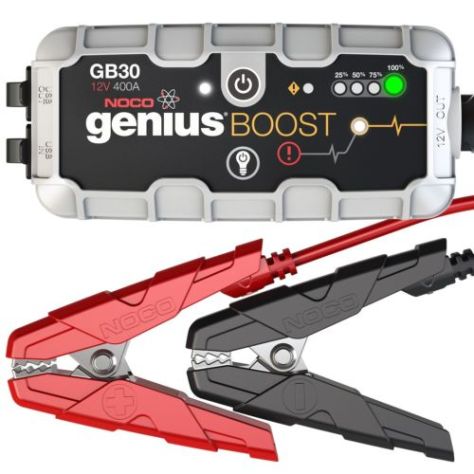
Maintenance-free Portable Starting Aid
If your car wont start and the starter motor is turning as normal:
- Is there fuel in the tank, If not replenish.
- Is there moisture on electrical components under the bonnet, if so wipe any dampness or moisture with a dry cloth. Spray a water repellent such as WD 40 or similar, on the ignition and fuel system connectors.
|
Electrical System Basics |
Jump Starting
|
Jump Starting will get you out of trouble, but you will have to correct what ever made the battery go flat in the first place:
- The battery has been drained by repeated attempts to start, or by leaving the lights on.
- The Charging system is not working properly, alternator drive belt slack or broken, a wiring fault , the alternator faulty itself.
- The Battery itself is at fault, electrolytes low or battery worn out.
Changing A wheel
Do not change a wheel in a situation where you risk being hit by other traffic. On busy roads, try to stop in a lay -by or a gateway. be wary of passing traffic whilst changing the wheel it is easy to get distracted by the job in hand.
-
- When a puncture occurs stop as soon as it is safe to do so.
- Park on firm level ground, if possible and well out of the way of other traffic.
- Use hazard lights if necessary.
- if you have one, use a warning triangle to alert other drivers of your presence.
- Apply the handbrake and engage first or reverse gear (or park on an automatic vehicle.)
- Chock the wheel diagonally opposite the one being removed, a couple of large stones will do this.
- If the ground is soft,use a flat piece of wood to spread the Load.
Tyre repair kit
Ideal for use as a puncture aid.
 This super handy repair kit offers speed and convenience. You don’t have to dismantle the wheel in order to use it!
Older tyres are prone to balding and more punctures, so use this sealant as a preventative measure when you don’t have a new tyre on hand.
The 450 ml bottle is sufficient quantity for all common car tires and the set comes in a practical storage bag for easy transport.
£ 24.99
Towing
When all else fails, you may find yourself having to get a tow home, or you maybe helping somebody else. Long distant recovery should only be done by a garage or breakdown service. For shorter distances, DIY towing using another vehicle is easy enough.
https://www.gov.uk/towing-with-car

Only attach the tow rope to the towing eyes provided within the tool kit for your vehicle, to fit the towing eye remove the circular cover from the front or rear bumper as required. The towing eye screws in anti clockwise as far as it goes using the handle of the wheel brace to turn the towing eye.
Only use a proper tow rope they are not expensive,the vehicle being towed must display an on tow sign on the rear of the towed vehicle where it can be seen.
Always have the ignition in the on position of the vehicle being towed to release the steering lock, this also provides power for the indicators and brake lights to work.
Before being towed release the handbrake, and ensure the vehicle is in neutral gear. For Automatics vehicles if they need to be towed should be in neutral do not exceed 50 mph and limit the distance to no more than 30 miles. A suspended tow is recommended for a vehicle with automatic transmission. If in doubt do not tow the vehicle as transmission damage may occur.
Note that greater than usual pedal pressure will be required to operate the brakes, since the vacuum servo unit is only operational with the engine running. Greater than usual effort will also be required to steer the vehicle.
The driver of the vehicle being towed must keep the tow rope taut to avoid snatching, ensure both drivers know the route that is going to be taken whilst vehicles are on tow before setting off.
Only drive at moderate speeds, keep the distance to be towed to a minimum. Drive smoothly and allow plenty of time for slowing down and stopping at junctions.

 Car Corners